
A management plan that self-maintaining
Flushing cycles, temperatures, and deviations automatically recorded. During an inspection, you show the logbook instead of reconstructing it.
The plan is not the problem, the registration is
A management plan stands or falls by what is recorded. And recording is exactly the work that is skipped during the peak season.
The clipboard that is left behind
Someone walks by the tap points, notes down, signs off. Until it gets busy and the round is skipped for a week.
A tap point outside the norm
Without continuous measurement, you only know during the next round that it has been too cold all this time.
The inspection that asks for proof
What is not recorded has not happened. Reconstructing afterwards is not an option.
Paper is the weak point
A management plan depends on registration. In practice, someone with a clipboard checks the tapping points, and during peak season, that round might sometimes be skipped.
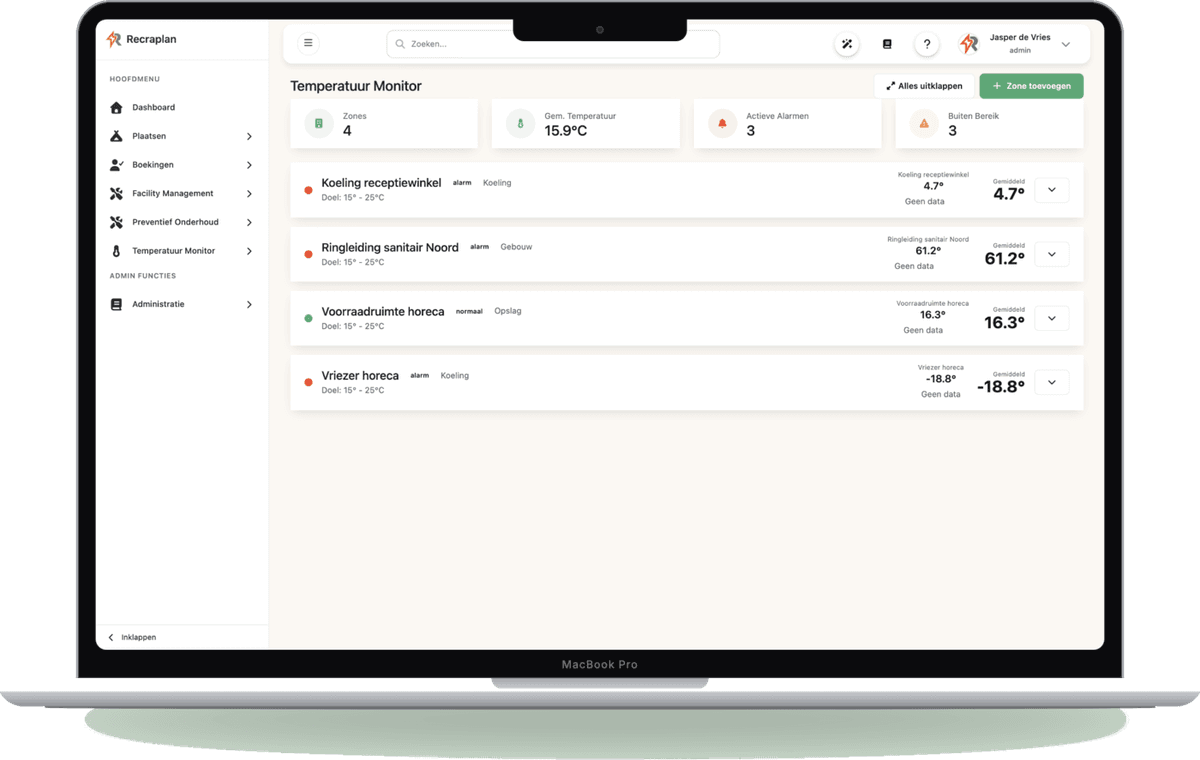
With digital sensors at the tapping points, temperatures are automatically recorded, and you can immediately see which tapping point is out of norm.
During an inspection, you have a complete logbook that no one had to fill in.
What changes as soon as the system registers
Not less work on your management plan, but no work.
A logbook that fills up automatically
Temperatures and flushing rounds are automatically recorded, along with the timestamp.
Deviations as they happen
A tap point that operates outside the norm reports itself instead of you discovering it next week.
Ready for an inspection
During an inspection, you show the logbook instead of searching for it.
One dashboard with the rest
Legionella stands alongside electricity, gas, and water, so it’s not another separate system.
Why temperature is key for legionella
Legionella is a bacterium that lives in drinking water and makes you sick when inhaled in small droplets — from a shower head, a fountain, or a hot tub. The most severe form is pneumonia, which can be fatal.
The bacterium grows best between 20 and 45 degrees. Therefore, every management plan revolves around temperature: keeping hot water hot enough, cold water cold enough, and being able to demonstrate that.
That proving is the work. Our sensors record the statuses every ten minutes, so the logbook fills itself, and you see a deviation the same day instead of at the next round.

Frequently asked questions about legionella management
What belongs in a management plan, and which part you can let run.
Is your logbook still on paper?
We show how temperatures are recorded automatically, and what else you need to do yourself.