

Why the number of amperes at a camping site says nothing about energy consumption
At many camping sites, the number of available amperes is seen as the benchmark for energy consumption. But is that really true? Modern campers and caravans are now equipped with smart technology, allowing them to adjust their power consumption to the available power capacity. This makes traditional thinking about amperes as an indicator for usage outdated. In this blog post, we explain why the number of amperes per camping site says little about actual energy consumption. We also demonstrate how smart energy management systems play a role in more efficient power consumption on your site.
The misconception about amperes and consumption
The number of amperes per camping site is often used as an important selling point. However, it is a limited measure. Modern campers and caravans can automatically adjust their power demand to the connection's strength. For instance, if a site only provides 6 amperes, the camper or caravan will slow down charging the battery or using heavy appliances like air conditioning. This means that the power demand is simply spread over a longer period. However, the total consumption in kWh over 24 hours remains the same, regardless of whether 6, 10, or 16 amperes are available.
An example: an electric boiler that normally requires 2 kW of power can operate on half power in a camper with a smart inverter at a lower amperage limit. It takes longer to heat the water, but energy consumption remains the same.
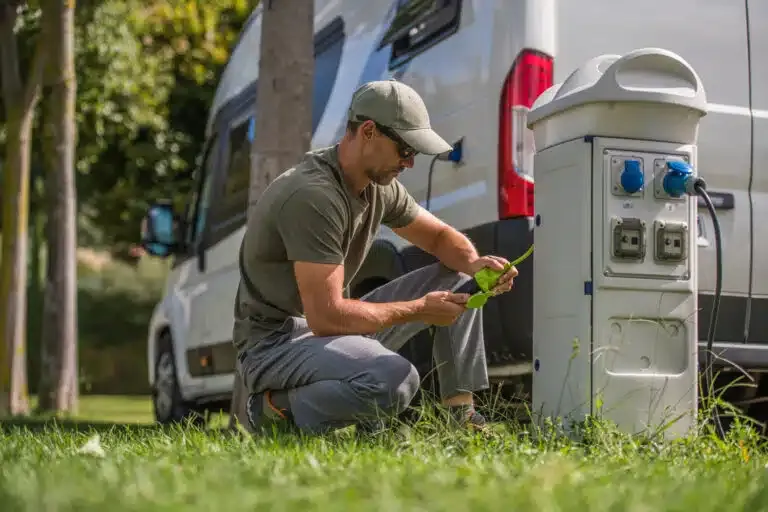
Efficient energy management requires more than just amperage adjustments
1. Simultaneity factor and cable capacity
At many campsites, a standard of 6 amperes per site is still used. At first glance, this seems like a simple solution to prevent overloading the grid. But how often do campers use all their devices at the same time? This is where the simultaneity factor becomes important.
By calculating how often and how intensively different users draw power, you can utilize the total cable capacity on your site much more efficiently. With smart energy management systems, you can monitor power usage and see where peak loads occur. This provides insight into where upgrades are needed and prevents unnecessary investments in cables and installations.
2. Smart meters and pay-as-you-go
Another solution is to have campers pay based on actual power consumption rather than a flat rate. Research shows that pay-as-you-go reduces energy consumption by an average of 20-25%. This is because campers become more conscious of energy when they know they pay for what they use. This includes turning off electric heating or using a kettle less often.
With smart meters, you can keep track of how much energy a camper consumes. This not only makes power usage fairer but also helps you as an entrepreneur to invest more targetedly in your energy infrastructure.
Sustainability and future-proof management
By looking beyond traditional 'ampere thinking' and investing in smart energy management systems, you can manage your camping site more efficiently and sustainably. The combination of:
- smart technology in campers and caravans,
- the use of simultaneity calculations,
- and pay-as-you-go
results in lower energy consumption and a more sustainable business operation. You avoid unnecessary investments in heavy cables or transformers and can future-proof your site for the growing demand for electric vehicles and solar panels.
Conclusion: amperes are not the measure of consumption
The number of amperes you offer at a camping site is just one part of the story. Modern technologies and smart energy management systems make it possible to handle electricity more efficiently, regardless of the number of amperes. Do you want to know more about how to prepare your camping site for the future with smart energy solutions?
Then contact us via RecraPlan.Together we will find the best solution for your site.