

LoRa and LoRaWAN
LoRa (Long Range) is a wireless technology specifically developed for transmitting small amounts of data over long distances with low power consumption. LoRaWAN (Long Range Wide Area Network) is the protocol that uses LoRa and manages communication between sensors and network gateways. This protocol ensures secure and reliable data transfer with end-to-end encryption. LoRaWAN networks are designed to be easily expandable, making them ideal for large-scale IoT implementations.
We are happy to share more about the technology and benefits of LoRa. Contact us, and we would be glad to visit your location to tell you more about the innovative solutions from RecraPlan and LoRa.

Types of LoRa sensors at RecraPlan
At RecraPlan, we use two types of LoRa sensors: Class A and Class C.
1. Class A sensors
These sensors can only transmit data from the sensor to the gateway; there is no return communication. They are configured to send data periodically or in case of an anomaly. During these intervals, the sensors 'sleep' to save energy. For example, a temperature sensor that sends the temperature every 10 minutes. During the intervals, the sensor consumes hardly any energy, allowing it to often run on a battery that lasts up to 10 years. The battery life can be further optimized by adjusting the transmission interval, for example, every 30 minutes instead of every 10 minutes.
2. Class C sensors
These sensors are continuously active, allowing commands to be sent directly from the RecraPlan server, such as turning power on or off. Although these sensors consume more power as they are always active, they offer the ability to send commands remotely. Depending on the specific requirements of a project, we determine which LoRa sensors are most suitable.
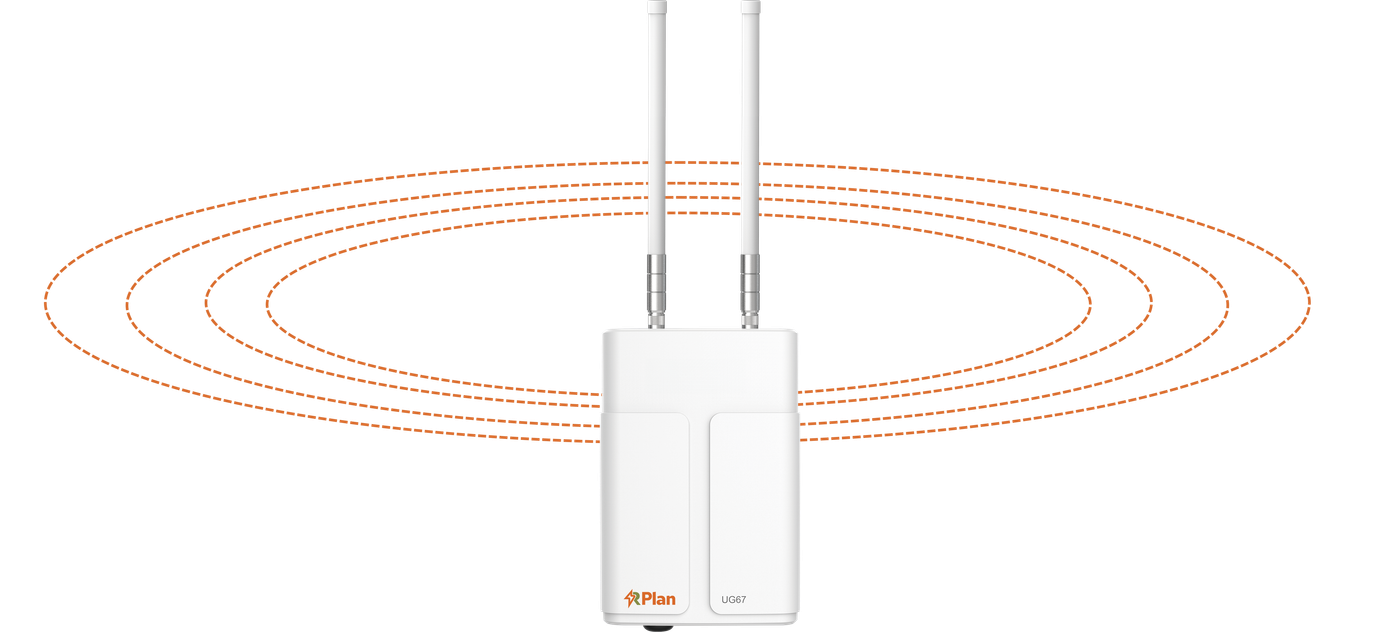
Difference between WiFi and LoRa
A significant difference between WiFi and LoRa is the distance over which communication can occur. LoRa can transmit data over several kilometers, while WiFi is limited to a few meters. Additionally, a WiFi device uses much more energy, making it difficult to offer a battery solution. LoRa signals can also penetrate walls and other obstacles more easily. For a customer, we have, for example, water meters that are placed underground and can still communicate perfectly with a gateway that is several hundred meters away. A disadvantage of LoRa is that it can only transmit small data packets, which is usually not a problem for sensors that send meter readings, temperature values, etc., but does limit the transmission of large files such as photos or videos.
Advantages of LoRa at RecraPlan
At RecraPlan, we fully embrace LoRa technology due to its scalability and reliability. A standard RecraPlan LoRa gateway can read up to 2000 sensors. Pairing a sensor is simple: all you need are the security keys of the sensor. These unique keys are entered once into the system, after which the sensor is immediately connected. Thanks to these security keys, all data is heavily encrypted, providing a secure means of communication. This is why LoRa is also widely used in industrial environments.